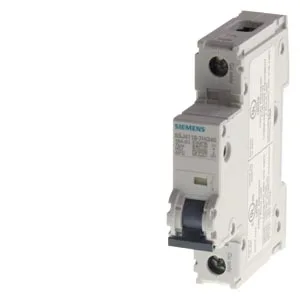
Rated for 400 V AC and 60 V DC, with a breaking capacity of 10 kA per EN 60898 and 15 kA per IEC 60947-2. Insulation voltage (Ui) is 440 V AC, so it's comfortable on 400 V line-to-line systems.
One modular width (18 mm) means it takes up a single slot on the DIN rail. The 70 mm installation depth is the same as the body depth — no extra projection behind the rail. IP20 with conductors connected; IP40 in the handle range. That's fine for a standard IP54 or IP65 enclosure — the breaker itself doesn't need a sealed front. Vibration resistance tested to 50 m/s² at 25 to 150 Hz and 60 m/s² at 35 Hz (4 seconds). That covers most industrial machinery — conveyors, compressors, pumps — without needing a separate shock mount.
The C-curve (5–10x In) is the workhorse for general industrial loads. If your circuit feeds purely resistive heaters or long cable runs with no inrush, a B-curve would trip faster on a short circuit. If it's a high-inrush transformer or large motor starter, a D-curve (10–20x In) might be needed. For most panel loads — contactors, relays, small VFDs, solenoid valves — the C-curve is the right call. Rated for 50 Hz only. If your site runs 60 Hz, this breaker's magnetic trip characteristics are calibrated for 50 Hz zero-crossing behavior; a 60 Hz supply could shift the trip threshold slightly. Check the application — for simple overcurrent protection on 60 Hz, the difference is usually negligible, but for coordinated selectivity with downstream devices, use the 50 Hz rating as published. Sealable (provision for a lock or tag-out hasp) — useful for lockout/tagout procedures on a machine panel. Neutral conductor switching is not provided (this is a 1-pole breaker for the phase only; neutral is either a solid bus or a separate switched neutral block).