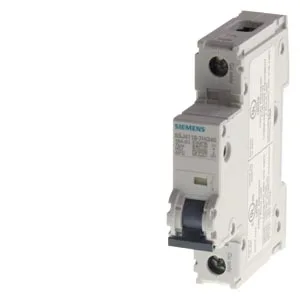
What the B-curve and 32 A rating mean for your branch
At 32 A, it protects a 7.5 kW single-phase load at 230 V or a 3.5 kW load at 400 V line-to-neutral, typical for lighting subcircuits, socket outlets, and control transformers in a distribution board. The DC rating of 60 V means this breaker can also serve in 48 V DC control buses or 24 V DC power supplies, though the 32 A AC rating derates at DC — the 60 V maximum is the voltage limit, not a current rating at that voltage. For pure DC circuits, verify the manufacturer's DC derating curve before committing the BOM line.
Sealable (padlockable) handle allows lockout/tagout compliance on the branch circuit.
The part carries no official successor because it is the active variant. If you are cross-referencing a panel originally built around the 5SL series, the 5SJ4 shares the same 1-module footprint and B-curve philosophy, but verify terminal compatibility — the 5SJ4 uses combined terminals (tunnel + cage) while some 5SL variants use tunnel only. No rewiring should be needed for a like-for-like swap on DIN rail, but check the conductor size and torque spec against your existing assembly.
Operating temperature range is -40 °C to +75 °C, with a derating curve above 40 °C — at 60 °C the breaker carries 28.16 A, not the full 32 A. Vibration resistance tested to 50 m/s² at 25–150 Hz and 60 m/s² at 35 Hz (4 seconds), which suits it for machinery and conveyor applications where the panel is mounted on the moving equipment. Designation per IEC 81346-2 and DIN EN 61346-2 is function code F (protective device). The product function note specifies terminal torque for Cu conductors at 60/75 °C rating — this is the tightening spec that matters for avoiding loose connections in high-vibration environments.