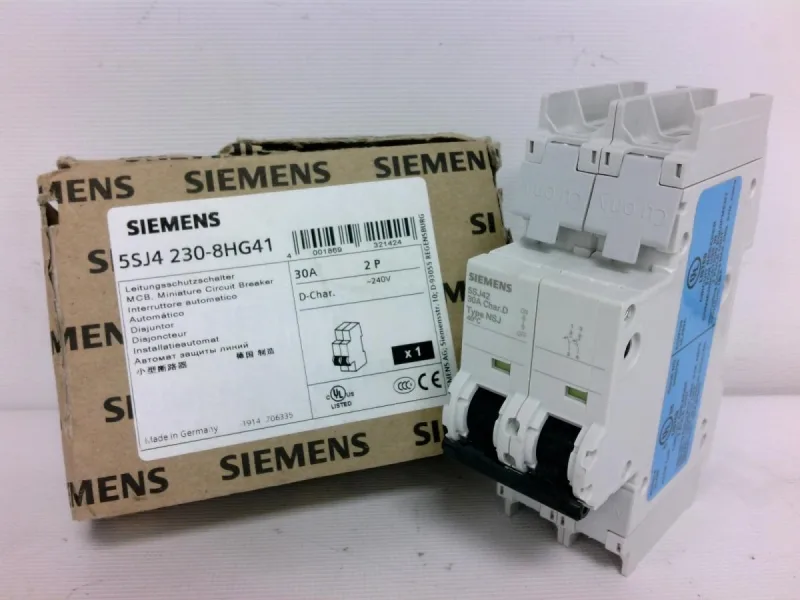
Rated 10 kA breaking capacity per EN 60898 and 15 kA per IEC 60947-2 at 400 V AC, it handles fault currents up to those levels without upstream coordination issues. The 2-pole form switches both phase conductors; no neutral pole is built in.
The D-curve is the headline selection parameter here. Unlike a B-curve (for resistive/lighting loads) or C-curve (general-purpose), the D-curve's magnetic trip threshold of 10–20× In is sized for motor feeders and transformer primaries where the inrush can hit 12× full-load current for a few cycles. If your BOM calls for a D-curve MCB, this is the correct family — swapping to a C-curve risks nuisance tripping on start-up. The 10 kA (EN 60898) and 15 kA (IEC 60947-2) ratings cover the two common certification regimes; the higher IEC figure matters for industrial installations where the prospective short-circuit current exceeds 10 kA. Rated operational voltage is 400 V AC and 60 V DC. The DC rating is limited to 60 V — not a 125 V DC rail breaker. For DC circuits at higher voltages, a different 5SJ4 variant with a higher DC rating is needed.
Mounting position is unrestricted — vertical, horizontal, or upside-down; the mechanism works the same. Depth is 70 mm, which matches the standard 70 mm installation depth for most 5SJ4 enclosures. IP20 at the terminals (finger-safe with connected conductors) and IP40 in the handle area — fine for enclosed panels; not rated for washdown.