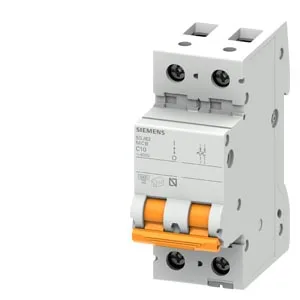
SENTRON 5SJ6150-7 — 50 A C-curve MCB, 1-pole
The Siemens 5SJ6150-7 is a SENTRON 5SJ6 miniature circuit breaker, single-pole, with a C tripping characteristic rated at 50 A. It breaks fault currents up to 6 kA per EN 60898 and IEC 60947-2, which covers the majority of residential and light commercial panelboard applications. The C-curve (5–10× In) makes it the standard choice for inductive loads like small motors, contactor coils, and lighting banks where inrush is moderate — not the steep surge of a large transformer (which would want a D-curve), and not the purely resistive load a B-curve would protect. It occupies 1 width unit on a DIN rail, so it fits a standard 18 mm module slot in any SENTRON distribution board.
What the ratings mean for fit
The 50 A rating at 240 V AC is the continuous current the breaker carries without tripping. The 6 kA breaking capacity per EN 60898 means it can safely interrupt a short-circuit fault up to 6,000 A — the standard for final circuits in most European distribution boards. The C-curve holds through momentary inrush up to 10× rated current before the magnetic trip fires, so it won't nuisance-trip on a motor start or a capacitor bank energisation. The 1-pole form factor is for single-phase branch circuits; if you need two-pole protection for a 400 V line-to-line load, the 5SJ6220-6 (20 A, B-curve) or 5SJ6216-6 (16 A, B-curve) share the same 70 mm depth and wire range, but swap the pole count and curve.
Panel integration notes
Mounts in any position on a 35 mm DIN rail. Installation depth is 70 mm, which matches the standard SENTRON enclosure depth — no extra clearance needed behind the panel door. The terminals accept solid or stranded conductors from 0.75 mm² up to 25 mm², covering everything from 1.5 mm² lighting circuits to 10 mm² feeder tails. The IP20 rating (with conductors connected) is typical for enclosed distribution boards; the breaker itself is touch-protected per the product feature. Halogen-free and silicon-free construction matters if the panel is in a clean room or a zone where outgassing could contaminate optics or contacts.
