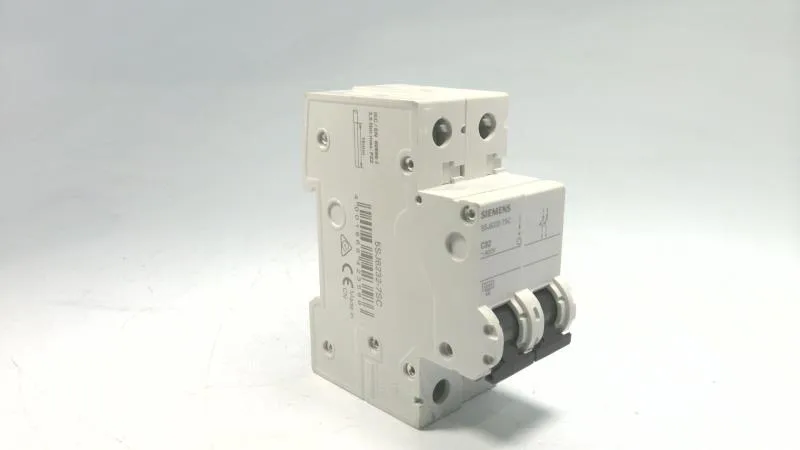
The C-curve means it holds through motor inrush (typically 5-10x rated current) and trips on sustained overloads, so it's a common choice for general-purpose branch circuits feeding motor starters, contactor coils, or small power supplies.
For an industrial panel fed from a transformer with higher available fault current, you'd need to check the upstream SCCR — this breaker coordinates fine downstream of a 10 kA or 16 kA main, but it won't clear a 10 kA fault on its own. The 2-pole configuration handles single-phase 230 V loads or two legs of a three-phase system; a 4-pole variant would be needed for three-phase + neutral.
The C-curve and 32 A rating suit it for general-purpose branch circuits — lighting, socket outlets, small motor loads — where the inrush isn't extreme but the load isn't purely resistive. No special wiring beyond the standard screw terminals; torque to the manufacturer's spec on the nameplate.