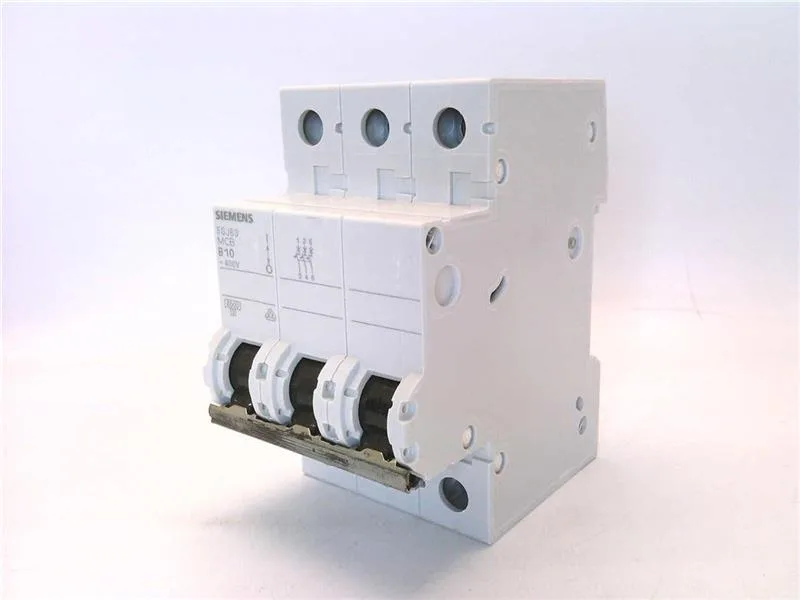
What this 5SJ6340-6 is and what the ratings mean for fit
The Siemens 5SJ6340-6 is a SENTRON 5SJ6 miniature circuit breaker — a 3-pole, 40 A, B-curve device rated for 400 V AC with a 6 kA breaking capacity certified to both EN 60898 and IEC 60947-2. The B tripping characteristic means the magnetic trip operates at 3 to 5 times rated current, so it's sized for resistive and general-purpose loads where inrush is modest — lighting circuits, control transformers, heater banks — not motor starting where a C or D curve would be needed to avoid nuisance trips on the inrush. The 6 kA breaking capacity at 400 V tells you it can safely interrupt a fault current up to that level without welding contacts or cascading failure upstream, which is the standard rating for most commercial and light industrial distribution boards. The 40 A rating is the continuous current it carries without tripping in a 30 °C ambient; the thermal-magnetic element tracks the load curve through the B band. The 5SJ6 design uses a 70 mm installation depth and mounts on standard DIN rail in any position — no orientation restrictions for the thermal trip. It occupies 3 width units (roughly 54 mm of rail space). The IP20 rating with connected conductors means it's protected against finger contact but not against moisture ingress; it belongs inside a panel or enclosure, not in a washdown zone.
Sourcing and lifecycle — what to expect when ordering
The 5SJ6 series is a mature, widely deployed platform. Compliance documentation — including RoHS, REACH, and the relevant IEC/EN standards — is provided with the part. The 5SJ6340-6 carries approvals per EN 60898 and IEC 60947-2, which cover the majority of European and international installation codes.
Terminal capacity and wiring
The screw terminals accept solid conductors from 0.75 mm² up to 25 mm² and stranded conductors across the same range. That 25 mm² upper limit is generous for a 40 A breaker — it lets you land the full-size feeder cable without a ferrule or reducer, which simplifies panel wiring when the breaker feeds a sub-distribution board or a high-current load. The terminals are sealable, meaning the manufacturer provides a means to lock or seal the terminal screws after torquing, which is a requirement in some metering or utility applications to prevent tampering. The breaker is halogen-free and silicon-free throughout its construction — relevant if the panel is installed in a clean-room environment or a zone where outgassing from a fault could contaminate optics or electronics.