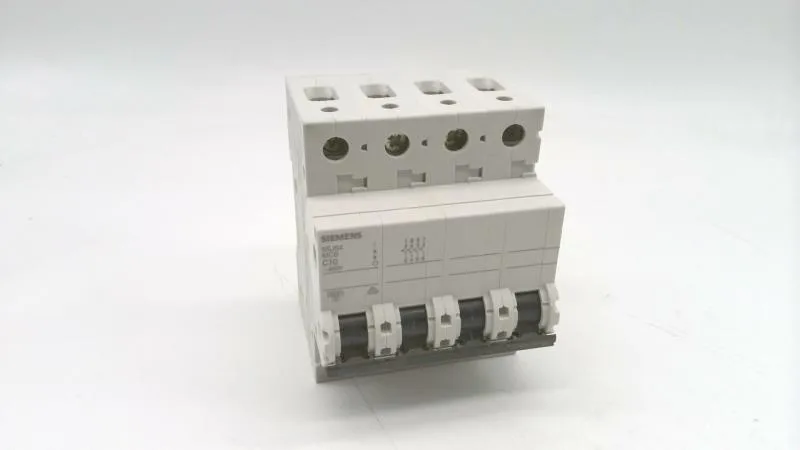
If your fault level exceeds 6 kA, you'll need to step up to a higher-breaking MCB or add a current-limiting upstream device. The four poles let you switch and protect all three phases plus neutral in a single unit — common in three-phase distribution panels where neutral protection is required. It occupies four width units (4 x 18 mm) on the DIN rail, so plan for 72 mm of rail space.
Integration notes — what fits and what doesn't
Installation depth is 70 mm — check your enclosure depth before committing. The terminal design accepts conductors up to the standard cross-section for a 14 A MCB; no special lug kit required. It's rated for AC and DC operation — on DC the maximum rated voltage is 60 V, so it can serve in DC sub-circuits up to that level. The insulation voltage is 440 V AC, and the overvoltage category is 3, meaning it's suitable for fixed-installation distribution boards. Vibration resistance per IEC 60068-2-6 is 50 m/s² at 25 to 150 Hz and 60 m/s² at 10 to 150 Hz — robust enough for most industrial panels but not for direct mounting on a high-vibration machine frame without additional damping.
The closest peer in the same 5SJ6 family is the 5SJ6463-7 — same 4-pole, C-curve, 6 kA breaking capacity, same physical footprint and mounting. The difference is the current rating: 63 A versus 14 A. If your BOM calls for 14 A, the 63 A version won't provide the same overcurrent protection — it would let a fault ride through. There's no direct drop-in substitute without rewiring the branch circuit. Stick with the 5SJ6414-7 for a 14 A circuit.