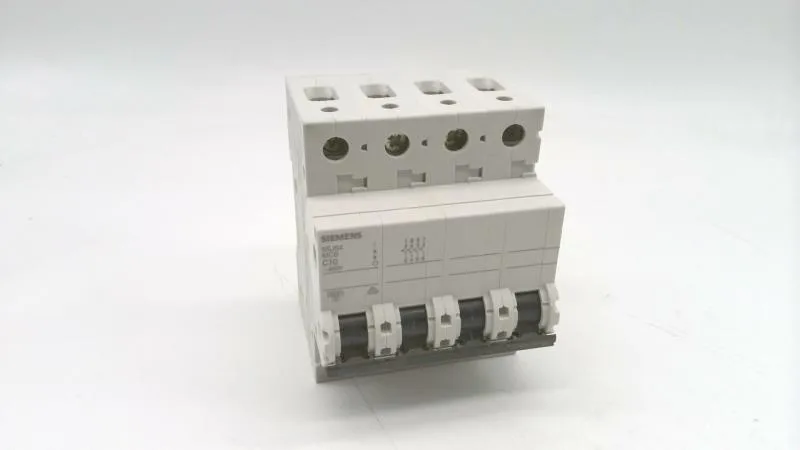
The Siemens SENTRON 5SJ6415-7 is a 4-pole miniature circuit breaker rated 1.6 A at 400 V AC with a C-curve tripping characteristic — meaning it handles moderate inrush from small motor or lighting loads without nuisance trips, but still clears overloads fast enough for branch-circuit protection. That 6 kA rating is identical across the 5SJ6 family, so the 1.6 A current rating is the selection gate — this is the right breaker for a 1.6 A load, not a general-purpose 4-pole spare. If the load is purely resistive or has a very low inrush, a B-curve sibling would trip faster on a minor overload; if the load has a high inrush like a motor starting direct-on-line, a D-curve might be needed. For a 1.6 A branch, the C-curve is the standard choice for mixed loads in a panel. The 70 mm installation depth and IP20 protection with connected conductors are standard for DIN-rail mounting inside a panel; no special enclosure needed.
The conductor terminal accepts solid and stranded wire from 0.75 mm² up to 25 mm² — that's a wide range covering everything from a 1.5 mm² control circuit to a 16 mm² feeder. The sealable feature means the breaker can be locked in the OFF position for LOTO compliance, which is a requirement on many industrial panels.
The 4 width units at 70 mm depth match the footprint of every other 4-pole 5SJ6 breaker, so swapping in a different current rating later means no re-drilling or re-wiring. Ambient temperature range is -20 to +45 °C, with periodic tolerance up to +55 °C and 95% humidity — fine for most indoor panel environments, including non-conditioned enclosures. The overvoltage category is 3, which covers fixed-installation distribution boards — the standard for building and industrial power panels. Vibration resistance per IEC 60068-2-6 is 50 m/s² at 25 to 150 Hz and 60 m/s² at 10 to 150 Hz, so it holds up on machinery with moderate vibration.
Mechanical endurance
Rated for 20 000 mechanical switching cycles typical. That's the standard endurance for this class of MCB — fine for a distribution board that sees infrequent operation, but not a switching-duty device. If the breaker is being cycled daily as a disconnect, expect to replace it earlier than the electrical life suggests.