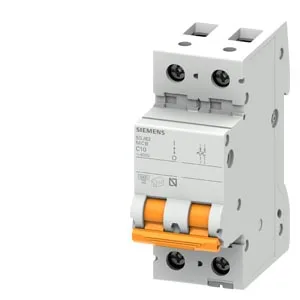
Rated voltage is 240 V AC single-phase, and the breaker can handle up to 440 V AC in multi-phase operation — so it works in split-phase or line-to-neutral configurations without derating the interrupting rating.
The 6 A rating governs continuous load: you size the downstream circuit so the steady-state current stays under 6 A. The C-curve sets the magnetic trip threshold to 30–60 A — high enough to avoid nuisance trips on motor inrush or capacitor charging, low enough to clear a hard short before the fault energy damages wiring. That is a wide clamp — it takes a 1.5 mm² lighting tail as easily as a 6 mm² feed. The terminals are sealable, meaning the manufacturer allows a tamper-evident seal wire through the terminal screw; useful for utility meters or rental sub-panels where you need to lock the setting. Installation depth is 70 mm — standard for the 5SJ6 family, so it fits existing DIN-rail enclosures without a deeper gland plate. The breaker occupies 2 width units at 18 mm per unit, so 36 mm of DIN rail per pole. No washdown rating here.
The closest functional sibling in the same 5SJ6 family is the 5SJ6220-6. Both are 1P+N, 6 kA, 70 mm depth, same wire range. The differences: the 5SJ6220-6 is a B-curve (trips 3–5× In) and rated 20 A at 400 V AC, while the 5SJ6506-7 is a C-curve rated 6 A at 240 V AC. The B-curve suits resistive loads and short cable runs where inrush is low; the C-curve handles the moderate inrush of lighting or small transformers. The 5SJ6506-7 also has a lower voltage rating (240 V vs 400 V) because it is a 1P+N with a switched neutral, not a 2-pole breaker — the neutral pole is not rated for full line-to-line voltage. If your panel was specified around a 5SJ6220-6, the 5SJ6506-7 will physically fit the same DIN rail and terminal footprint, but the trip curve and current rating are different — you would need to verify the circuit's load and inrush profile before swapping.