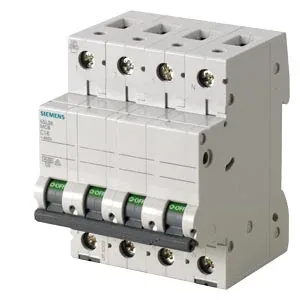
It's built for residential and infrastructure branch-circuit protection — think lighting panels, socket circuits, and small distribution boards where the C-curve handles moderate inrush from motors or transformers without nuisance tripping. Rated breaking capacity is 4.5 kA per EN 60898 and 5 kA per IEC 60947-2, so it's suited for domestic and light commercial service where fault levels stay under those thresholds. The 3P+N design switches all three phases plus a switched neutral — common in three-phase final subcircuits where you need to isolate the neutral for safe maintenance.
At 40 A rated current (at 30 °C ambient), this MCB carries a full 40 A continuously. But if the panel runs hot — say 40 °C inside the enclosure — the rating derates to 38.07 A; at 45 °C it's 36.8 A, and at 55 °C it drops to 34.97 A. That derating curve is the number to check when you're stuffing four of these into a crowded enclosure: the thermal rise between breakers matters more than the nameplate 40 A. The C-curve means the magnetic trip kicks in at 5 to 10 times the rated current — so for a 40 A breaker, instantaneous trip happens between 200 A and 400 A. That's a good fit for motor starters and small compressors that draw a startup surge, but not for high-inrush transformer loads (use a D-curve there). Power loss per pole is 3.3 W at rated current in hot operating state, so a 4-pole unit dissipates about 13.2 W total. In a sealed IP20 distribution board with multiple breakers, that heat adds up — plan ventilation or spacing if you're packing the rail.
Mechanical fit and integration
It occupies 4 modular width units (each 18 mm wide, so 72 mm total). Mounting position is any — upright, sideways, or upside-down — so it fits tight compartments without derating.