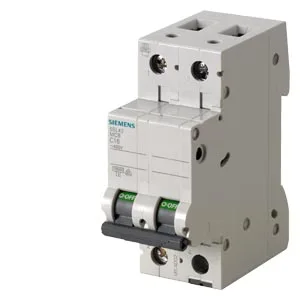
What the Z characteristic means for your circuit
That Z curve is the key spec here — it trips between 2 and 3 times rated current, which is tighter than a B curve (3–5× In) and much tighter than C or D. For a sourcing decision, the Z characteristic means this breaker is designed to protect sensitive electronic loads — PLC power supplies, control transformers, instrumentation loops — where a standard breaker might let through enough fault energy to damage downstream semiconductors.
Temperature derating and environment
The 40 A rating holds at 50 °C ambient. Above that, derate: 39.1 A at 55 °C, 38.1 A at 60 °C. At 30 °C the breaker can carry 43.6 A continuous.
Depth is 76 mm, height 90 mm, width 36 mm (2 modular units). Installation depth is 70 mm. Sealable, halogen-free, silicon-free construction. The 36 mm width matches standard 2-pole MCB footprint — drops into any panel designed for that form factor without rewiring.