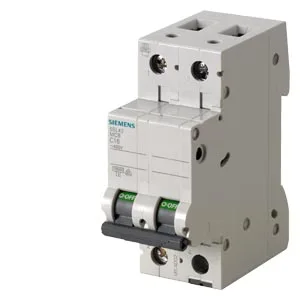
What this MCB is and what it does
The Siemens SENTRON 5SL4240-7 is a 2-pole miniature circuit breaker rated 40 A with a C-tripping characteristic, designed for AC branch-circuit protection in residential and light-commercial infrastructure panels. It breaks fault currents up to 10 kA per both IEC 60898 and IEC 60947-2, so it can handle typical utility-side fault levels without cascading upstream. The C-curve (5–10× In magnetic trip) suits moderate inrush loads like small motor starters, lighting contactors, and distribution subfeeds — not the steep surge of a transformer primary, but enough margin to avoid nuisance trips on capacitor or fan starts.
Fit and panel integration
Occupies 2 modular-width units (36 mm) on a DIN rail, with a 76 mm depth and 90 mm height — standard SENTRON footprint that drops into any 18 mm-pitch distribution board. Mounting position is unrestricted, so it can be installed horizontally or inverted if the enclosure layout demands it. The IP20 rating (with connected conductors) is the norm for enclosed panel-mount gear; no special sealing required inside a rated cabinet.
What the ratings mean for the buyer
The 10 kA breaking capacity is rated identically under both IEC 60898 (the household MCB standard) and IEC 60947-2 (the industrial standard for circuit breakers). That dual rating means the same part satisfies a residential distribution board and a light-industrial panel — no need to spec a different breaker if the application crosses between the two. The 400 V AC rated voltage covers single-phase and three-phase line-to-line supplies up to 440 V maximum. Each pole dissipates 3.3 W at rated current in hot state, which is modest enough that no special derating is needed in a standard 2-MW slot, but worth summing across a densely populated board for thermal calculations.
Accessories and compliance
The breaker accepts plug-in supplementary devices (auxiliary contacts, shunt trips, alarm switches) — the SENTRON accessory range fits without extra wiring. Halogen-free and silicon-free construction, so it meets the material restrictions common in rail, marine, and clean-room specs. Overvoltage category III and pollution degree 2 are standard for fixed-installation distribution.
