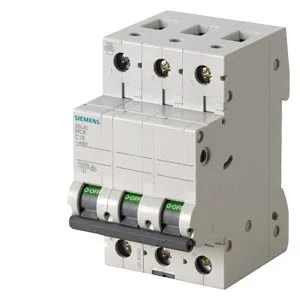
The 1 A rating is the continuous current at 30 °C; at 40 °C it derates to 0.95 A, at 45 °C to 0.92 A, and at 55 °C to 0.86 A, so a panel running warm needs a larger frame or a higher ampacity breaker. Breaking capacity of 10 kA at 400 V AC under both EN 60898 and IEC 60947-2 means this breaker can safely interrupt a fault current up to 10,000 A without welding contacts or cascading failure upstream. That's the standard residential and light-commercial SCCR; if your transformer or service entrance can deliver more fault current, you need a higher-rated device or a current-limiting upstream breaker. The 3-pole design (3P) switches all three phases simultaneously, which is what you need for a three-phase final subcircuit.
Sealable with a lead or tag, so a utility or facility manager can lock the setting against tampering. In a densely populated board, that heat adds up; factor it into your thermal calculation if the panel is near its fill limit.