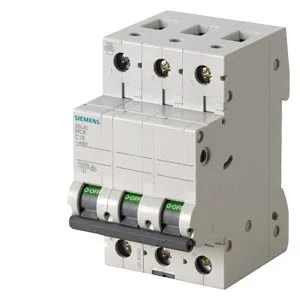
The Z curve trips between 2 and 3 times rated current — tighter than a B curve (3–5× In) — so it holds the unit on the grid for brief inrush but clears a fault before the silicon lets go. Breaking capacity is 10 kA per EN 60898 and 15 kA per IEC 60947-2 at 415 V AC, which means it can interrupt a fault up to that level without cascading upstream in a panel fed from a transformer of that capacity.
The Z characteristic is the deciding factor here. Standard MCBs for motor or general distribution use a C or D curve; this part is for circuits where the load is a rectifier, a switched-mode power supply, or a control transformer — devices that draw near-sinusoidal current with minimal inrush but can't tolerate a prolonged overcurrent. The 2 A rating means the continuous load should not exceed about 1.6 A (80 % derating per IEC 60947-2 for a warm enclosure) provided the ambient stays under 40 °C. Voltage rating covers 415 V AC phase-to-phase (3-pole) and 440 V AC maximum for multi-phase or single-phase operation, so it fits standard 400 V three-phase panels and 230/400 V TN systems. The DC rating tops out at 72 V, which limits its use on DC circuits to 48 V battery banks or 60 V control loops — not for 125 V DC substation batteries.
The breaker is sealable, so a panel builder can lock the toggle position with a wire seal or padlock hasp to prevent unauthorized reset after a trip.