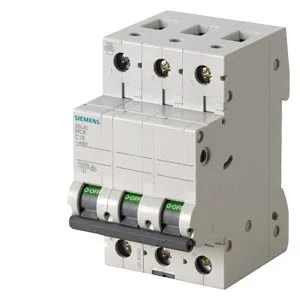
What the Z-characteristic means for your circuit
The Z curve trips between 2 and 3 times rated current — tighter than a B curve (3-5× In) and much tighter than C or D. That makes it the right choice for protecting sensitive semiconductor loads, control transformers, or electronic modules where a standard breaker would let through enough fault energy to damage the downstream device. It's not for general motor or distribution circuits; those need the wider curves to ride through inrush.
Breaking capacity and voltage — coordination headroom
Rated 10 kA breaking capacity under both IEC 60898 and IEC 60947-2, at 415 VAC (single-phase) and 440 VAC (multi-phase). That 10 kA figure is the same under both standards, which simplifies coordination — you don't need a separate upstream current-limiting device unless the prospective fault current exceeds 10 kA at the panel.
Thermal derating — real-world current capacity
The 10 A rating holds at 50 °C ambient. At 30 °C it carries 10.9 A; at 40 °C, 10.5 A; at 55 °C it drops to 9.8 A; at 60 °C, 9.5 A. If the panel runs hot — say 55 °C inside a sealed enclosure — the breaker will still hold 9.8 A continuous without nuisance tripping, but the Z-curve's magnetic trip point stays fixed. That derating table is useful when sizing for a densely packed DIN rail where ambient rise is unavoidable.
Mounting position is any orientation. Touch protection is built in. Halogen-free and silicon-free construction, sealable for tamper-evident installations.