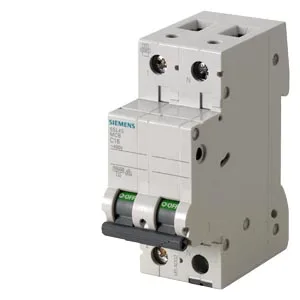
What this MCB is and where it fits
The Siemens 5SL4501-8 is a SENTRON miniature circuit breaker rated 1 A with a D tripping characteristic, 1P+N poles, and a 10 kA breaking capacity per both EN 60898 and IEC 60947-2 at 230 V AC. It occupies 2 modular-width units on a DIN rail and is designed for residential buildings and infrastructure installations — think distribution boards feeding lighting, socket circuits, or small motor loads where the D curve handles inrush without nuisance tripping.
What the ratings mean for your panel
The D characteristic means the magnetic trip fires at 10–20× In (10–20 A), so it's sized for loads with high inrush — small transformers, solenoid valves, or motor starters — without tripping on the start surge. At 1 A rated current, the thermal element holds steady up to 30 °C; above that it derates: 0.96 A at 40 °C, 0.94 A at 45 °C, and 0.9 A at 55 °C. If your enclosure runs warm, factor that derating into the load budget. Breaking capacity of 10 kA at 230 V AC covers most residential and light commercial fault levels — it safely interrupts a short-circuit current up to that magnitude without welding contacts or cascading upstream. The 1P+N design switches the line and opens the neutral, which is standard for single-phase final subcircuits in many regional wiring codes. Mechanical life is rated at 10,000 switching cycles typical — adequate for normal on/off duty in a distribution board; not intended for frequent load-break switching like a contactor. Power loss per pole at rated current is 1.1 W, so two poles dissipate about 2.2 W — negligible in a ventilated enclosure.
Panel integration notes
Mounts on standard 35 mm DIN rail in any position — vertical, horizontal, or upside-down — and occupies 2 modular-width units (36 mm wide). Depth is 76 mm (70 mm installation depth behind the panel surface). The housing is IP20 with connected conductors, so it's protected against finger contact but not washdown; keep it inside a closed distribution board. Sealable, halogen-free, silicon-free — suitable for clean-room or low-outgassing environments. Supplementary devices (auxiliary switches, shunt trips, undervoltage releases) can be snapped onto the right side — the product extension interface is present. Overvoltage category III and pollution degree 2 match typical fixed-installation conditions in a residential or commercial panel.