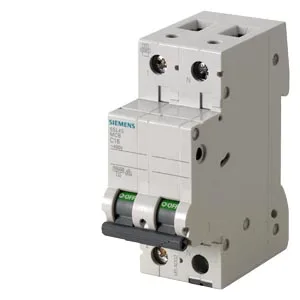
Breaking capacity is 10 kA per both EN 60898 and IEC 60947-2, which means it can safely interrupt a fault current up to 10,000 A without welding its contacts or rupturing the housing. That covers the vast majority of domestic and small commercial service-entrance fault levels across Europe and markets adopting IEC standards. The 1P+N pole configuration switches the line conductor and switches the neutral — the neutral is not protected, but it is disconnected when the breaker trips, which is the standard arrangement for single-phase final subcircuits in many territories.
Panel fit and mechanical details
The 90 mm height is standard for the SENTRON 5SL family, so it aligns with busbar systems and downstream accessories like shunt trips or auxiliary switches.
B-curve tripping (per EN 60898) means the magnetic trip operates between 3 and 5 times rated current — so for a 20 A breaker, instantaneous trip occurs between 60 A and 100 A. That is a good fit for resistive and lighting loads with low inrush; it is not the right choice for motor circuits or transformers where a C or D curve would avoid nuisance tripping on starting current. Power loss is 2.5 W per pole in hot operating state at rated current. In a multi-breaker panel, that heat adds up — factor it into your enclosure thermal budget if you are packing 20+ breakers in a small box.