What it is and what the ratings mean
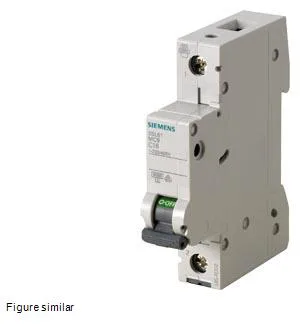
The Siemens SENTRON 5SL6115-7BB is a 1-pole miniature circuit breaker (MCB) with a C tripping characteristic, rated 1.6 A at 30 °C and breaking 6 kA per EN 60898 and IEC 60947-2. That C-curve means it trips between 5 and 10 times rated current — designed for moderate inrush loads like small motor circuits or lighting banks where you need the short-circuit protection without nuisance tripping on startup. The 6 kA interrupting rating tells you it can safely clear a fault up to that level at the rated voltage; in a panel with higher available fault current, you'd need an upstream current-limiting device or a higher-rated breaker. It handles single-phase AC up to 250 V and multi-phase up to 440 V AC, with a DC rating of 72 V maximum — so it covers most residential, commercial, and light industrial branch circuits. Temperature derating is built in: at 40 °C the continuous rating drops to 1.54 A, at 45 °C to 1.5 A, and at 55 °C to 1.43 A. If this breaker sits in a hot control panel — say near a kiln or in a non-climate-controlled enclosure — you need to size the load against the derated figure, not the 30 °C nameplate. The mechanical service life is 10 000 switching cycles, typical for this class of MCB.
Where it goes and how it fits
The 5SL6115-7BB snaps onto standard 35 mm DIN rail in any mounting position. It takes up one modular width unit (18 mm wide, 90 mm tall, 76 mm deep with 70 mm installation depth), so it fits tight panel layouts where every millimeter counts. The IP20 rating with connected conductors means it's protected against finger contact but not against dust or moisture — fine inside a clean enclosure, but if the panel sees washdown or cement dust, you'll want a separate enclosure or a higher-IP rated device upstream. It's sealable, halogen-free, and silicon-free, which matters for environments where outgassing can contaminate sensitive contacts or optics.