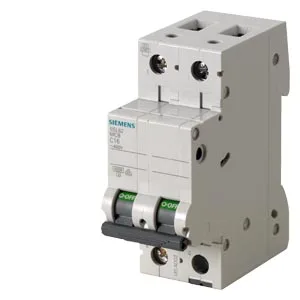
The Siemens 5SL6206-8CC is a SENTRON miniature circuit breaker (MCB) — a 2-pole, D-curve unit rated 6 A at 400 V AC, with a 6 kA breaking capacity tested to EN 60898.
The 400 V AC rated voltage covers 3-phase line-to-line supplies up to 440 V maximum in multi-phase operation. The 6 A rating is the continuous thermal current — the breaker will carry 6 A indefinitely at 30 °C ambient without nuisance tripping, and the D-curve's magnetic trip kicks in above 60–120 A for short-circuit events.
Where it goes — deployment context
Suitability for operation in residential buildings and infrastructure is the manufacturer's stated application field — think consumer units, sub-distribution boards, lighting panels, and small commercial DBs. The D-curve makes it a natural fit for motor circuits (pumps, fans, compressors) and small transformers where the inrush would trip a B- or C-curve breaker on energization. Mounting position is unrestricted, so it can be installed horizontally or vertically in a panel. The sealable design allows a lead seal or lock to prevent unauthorized operation — useful for utility-metered or shared-access boards. Supplementary devices like shunt trips, auxiliary contacts, or alarm switches can be added via the SENTRON accessory range.
How it compares to nearby siblings
The closest peer in the ledger is the 5SL4363-7 — a 3-pole, C-curve, 63 A breaker with a 10 kA breaking capacity per both EN 60898 and IEC 60947-2. The 5SL6206-8CC shares the same 76 mm depth, 90 mm height, and SENTRON platform, but at 36 mm wide (2 MWU) versus 54 mm wide (3 MWU). The D-curve on the 6 A unit is the key difference: the 5SL4363-7's C-curve is for general-purpose loads, while the D-curve here is specifically for high-inrush applications.