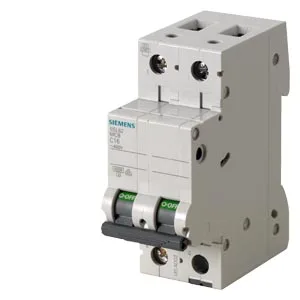
The Siemens 5SL6213-7 is a 2-pole SENTRON miniature circuit breaker rated 13 A with a C-curve trip characteristic. It breaks fault currents up to 6 kA per EN 60898 and IEC 60947-2 at 400 V AC, 50/60 Hz. That 6 kA rating is the interrupting capacity you size the downstream coordination against — it tells you the breaker can clear a bolted fault at that level without welding its contacts or rupturing the case.
Fit and panel integration
Occupies 2 modular width units (36 mm total) on a DIN rail. Depth is 76 mm, installation depth 70 mm — the extra 6 mm accounts for the front toggle throw. Mounting position is any, so it works in horizontal busbar arrangements or vertical sub-feed panels. IP20 with connected conductors, meaning it's protected against finger contact once wired but not against moisture; keep it inside a rated enclosure. Sealable design allows the installer to lock the toggle in the off position with a padlock hasp — useful for lockout/tagout on a dedicated circuit. Halogen-free and silicon-free construction matters if the panel is in a clean room or oxygen-enriched environment where outgassing could cause corrosion or contamination.
Electrical ratings and what they mean for the circuit
C-curve trips at 5 to 10 times rated current (65 to 130 A magnetic release), which is the standard choice for general-purpose distribution feeding resistive and light inductive loads — lighting, small transformers, control circuits. Not intended for motor starting inrush unless the motor FLA is well below 13 A and the starting current stays under the magnetic threshold. Rated for multi-phase operation up to 440 V AC maximum, with a pollution degree 2 and overvoltage category III — that's the typical environment for a fixed-installation distribution board where transients from upstream switching are expected. Power loss per pole is 1.9 W at rated current in hot operating state; for a 2-pole breaker that's 3.8 W total heat to dissipate inside the enclosure. Stack several of these in a row and the cumulative heat matters for the enclosure's thermal derating.