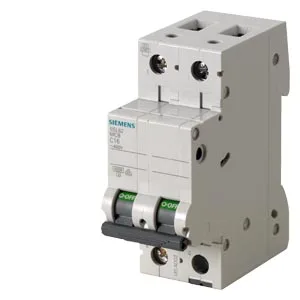
What it is and what it does
The Siemens 5SL6240-7CC is a 2-pole SENTRON miniature circuit breaker (MCB) with a C tripping characteristic, rated at 40 A at 400 V AC. The C curve means it's designed for moderate inrush loads — think small motor circuits, lighting banks, or general-purpose distribution where the start-up current isn't extreme but exceeds a resistive load's draw. The 6 kA breaking capacity (per EN 60898) tells you it can safely interrupt a fault up to that level without welding contacts or cascading failure upstream. That's standard for residential and light commercial distribution boards, not high-fault industrial switchgear.
Where it fits — panel and environment
This MCB snaps onto a standard DIN rail. At 36 mm wide (2 modular units), it occupies two adjacent slots in a consumer unit or sub-distribution board. The 76 mm depth leaves room for wiring behind the panel door; the 70 mm installation depth is the space you need inside the enclosure, not counting the front toggle. Mounting position is unrestricted, so you can orient it any way the panel layout demands. IP20 with connected conductors means it's protected against finger contact but not moisture — keep it inside a sealed enclosure if the environment is damp or dusty.
Thermal derating — the number that matters for real loading
The 40 A rating is at 30 °C ambient. At 40 °C it derates to 37.72 A; at 50 °C it drops to 35.3 A. If your panel runs warm — and most enclosed distribution boards do — the actual continuous current you can pull is lower than the label. The C-curve magnetic trip still holds its multiple, but the thermal bimetal element responds to the temperature it sees. Factor this in when sizing for a continuous load near the limit.
Environmental and compliance notes
Halogen-free and silicon-free construction, which matters if the breaker lives in a clean-room or semiconductor-adjacent environment where outgassing can contaminate optics or sensitive surfaces. Overvoltage category III and pollution degree 2 — standard for fixed-installation distribution. The vibration resistance of 50 m/s² at 25–150 Hz (per IEC 60068-2-6) means it holds up on machinery or in transport applications without nuisance tripping from mechanical shock.
