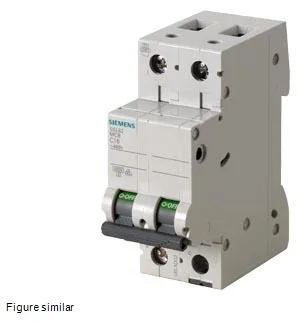
What this MCB does for a 40 A D-curve line
The Siemens SENTRON 5SL6240-8CC is a 2-pole miniature circuit breaker rated 40 A with a D tripping characteristic, designed to protect circuits on 400 V AC distribution (50/60 Hz). The 2-pole form factor switches both phase conductors in a single-phase or two-phase system — common in North American split-phase or European dual-phase sub-distribution.
Sizing and thermal reality for a 40 A D-curve
Power loss per pole is 4.8 W in hot operating state at rated current. For a 2-pole breaker in an enclosed panel, that's 9.6 W total dissipation — a real number for thermal coordination when the breaker shares a DIN rail with other heat sources. Mounting position is unrestricted, which simplifies panel layout — the breaker can be installed horizontally or inverted if the gland plate forces it. The 2-module width (36 mm per,) fits standard 18 mm/module DIN-rail spacing; depth of 76 mm and height of 90 mm match the SENTRON 5SL family footprint, so it swaps into an existing 5SL panel without re-drilling the rail or re-routing busbars.
Panel integration and compliance signals
The breaker is sealable, halogen-free and silicon-free — relevant for food-processing, pharmaceutical, or clean-room panels where outgassing or seal integrity matters. IP20 with connected conductors is the expected protection for a DIN-rail device inside a closed enclosure; the terminals are finger-safe only when wired. Supplementary devices (auxiliary contacts, shunt trip, alarm switch) can be snapped onto the right side. The 70 mm installation depth accounts for the device body plus the required wiring space behind the DIN rail — plan for at least that clearance from the back panel to the enclosure door.