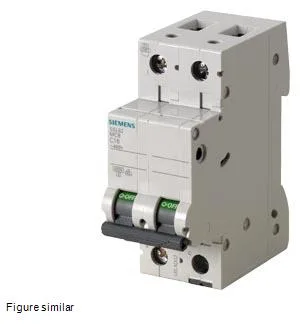
Siemens 5SL6250-7MB — 2-pole C-curve MCB at 50 A
The Siemens 5SL6250-7MB is a 2-pole miniature circuit breaker from the SENTRON series, rated 50 A with a C tripping characteristic. It breaks 6 kA at 400 V AC per EN 60898, which covers the standard fault-current duty for most residential and light-commercial distribution boards. The 2-module-width (36 mm) footprint snaps onto DIN rail and occupies two 18 mm slots — the same pitch as the wider 5SL6 family, so it retrofits into existing SENTRON sub-distribution panels without re-drilling the mounting rail.
What the ratings mean for fit
The C-curve means the magnetic trip fires at 5–10× In (250–500 A), so it handles motor inrush and transformer energisation without nuisance tripping, but still clears a hard short fast enough for cable protection. The 6 kA breaking capacity at 400 V AC is the standard domestic/commercial level — adequate for a 400 V three-phase sub-main where the prospective short-circuit current stays under 6 kA. If your installation has a transformer closer than about 10 m of cable, verify the PSC at the board; you may need the 10 kA variant. The 50 A rating at 30 °C is the continuous current the bimetal element carries without tripping — derate per the manufacturer's table above 30 °C ambient. The IP20 rating with connected conductors is standard for enclosed distribution boards; the breaker itself is not rated for wet or dusty environments.
Panel integration notes
Mounting position is any, so the breaker can be installed vertically, horizontally, or upside-down on the DIN rail without derating the 6 kA breaking capacity. The 76 mm depth plus 70 mm installation depth means the breaker body extends 70 mm behind the DIN rail — verify the enclosure depth if retrofitting into a shallow consumer unit. The sealable design allows the installer to lock the toggle in the OFF position with a padlock, meeting lockout/tagout requirements for downstream circuits. The neutral conductor is not switched — this is a 2-pole breaker that switches both phases (line and line) on a split-phase or two-phase system; for a single-phase application with a switched neutral, use a 1P+N variant.
