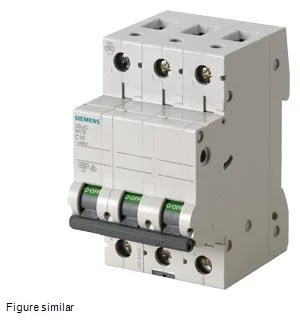
It breaks fault currents up to 6 kA per EN 60898 and IEC 60947-2 at 400 V AC — the standard interrupting rating for residential and light-commercial distribution boards in 50/60 Hz networks.
Depth is 76 mm (70 mm installation depth), which fits flush in most 85 mm deep distribution enclosures. Sealable terminals allow the installer to lock the cover after commissioning, a requirement in some utility-metered installations.
The closest peer in the same form factor is the 5SL4363-7 — identical dimensions (76×54×90 mm), same 3-pole C-curve 13 A rating, same 400 V AC / 440 V max, same 10 000 mechanical cycles, same sealable terminals. The difference is breaking capacity: the 5SL4363-7 carries a 10 kA rating per both EN 60898 and IEC 60947-2, versus 6 kA on this part. If the panel's prospective short-circuit current (PSCC) at the breaker's location is under 6 kA, the 5SL6313-7 is the correct fit. For a board fed close to a transformer where fault levels exceed 6 kA, step up to the 5SL4363-7. No wiring or busbar changes needed — same footprint, same DIN-rail clip.
Halogen-free and silicon-free construction — important for installations where off-gassing during a fault must not corrode adjacent contacts or sensitive electronics.