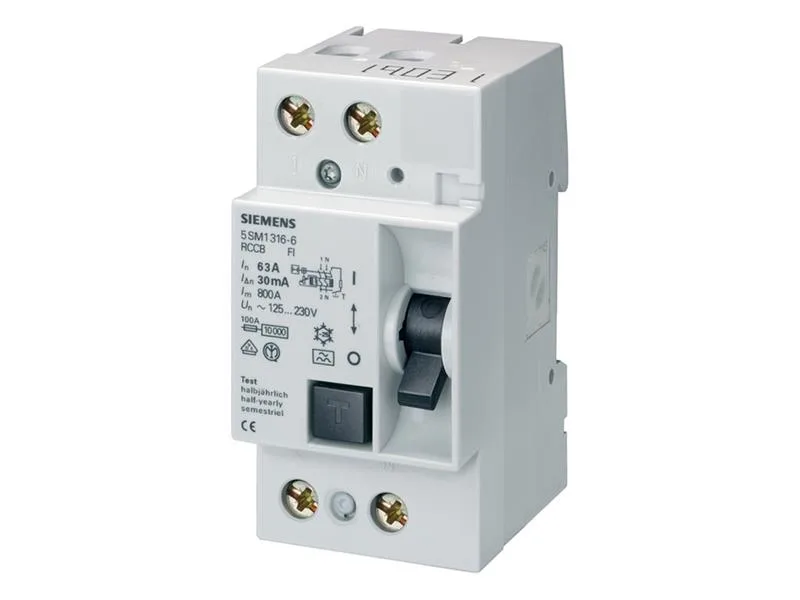
The Siemens SENTRON 5SM1316-0 is a 2-pole residual current circuit breaker (RCCB) rated for 63 A at 230 V AC, with a 30 mA trip sensitivity and Type AC fault current detection — the standard choice for protecting general-purpose circuits against sinusoidal AC earth faults in residential and commercial distribution boards. Its instantaneous (non-delayed) design means it trips within the first cycle of a fault, making it suitable for circuits without high inrush or surge currents that would cause nuisance tripping.
At 40 °C and 45 °C the device holds its full 63 A rating; above that, derating applies linearly: 60.48 A at 50 °C, 57.96 A at 55 °C, 55.44 A at 60 °C, 52.92 A at 65 °C, and 50.4 A at 70 °C — so if your panel ambient runs above 45 °C, size the upstream breaker for the derated value, not the nameplate 63 A. The short-circuit breaking capacity is 10 kA per IEC 61008-1, with a lower rating of 0.8 kA per EN 60898 — the EN number governs when the RCCB is used in a domestic final circuit under that standard; the 10 kA figure applies under the IEC product standard for RCCBs. The let-through energy (I²t) is rated at 70,000 A²·s, which helps with coordination downstream — the RCCB limits the energy let-through to a level that standard MCBs downstream can typically withstand without damage.
Installation depth is 55 mm — fits standard distribution enclosures without crowding the gland plate. Silicon-free construction means it won't outgas contaminants that could affect sensitive contacts or electronics in the same enclosure — relevant for panels with PLCs or signal conditioners sharing the airspace.
The test circuit supply requires a minimum of 100 V AC to operate the test button.