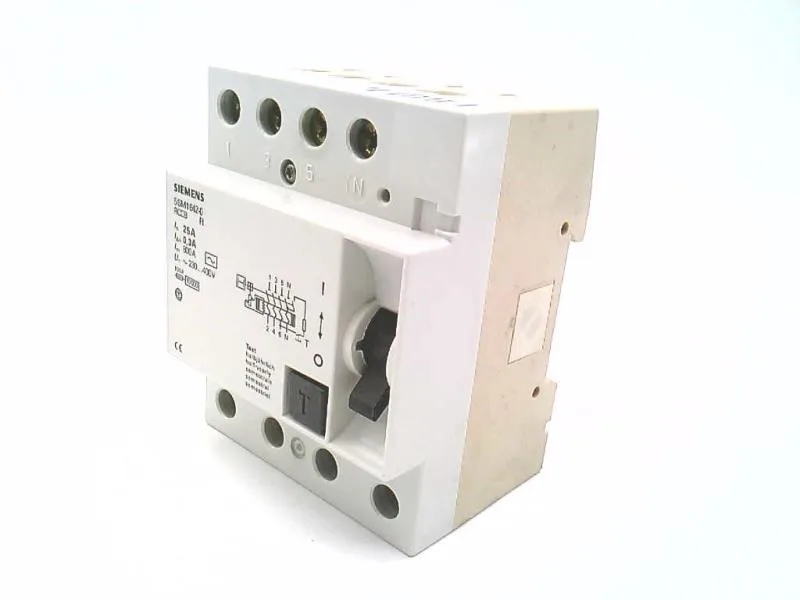
The Siemens 5SM1644-8 is a 4-pole selective RCCB from the SENTRON 5SM1 family, rated 40 A at 400 V AC with a 300 mA Type A residual current trip. The selective (S-type) design means it introduces a deliberate time delay, so it coordinates downstream with standard RCCBs — the downstream unit trips first on a ground fault, and this one only clears if the fault persists, keeping the rest of the sub-distribution live. That selectivity is the whole point: you install it at the distribution board incomer so a fault on one branch doesn't take down the whole floor. Mounts on DIN rail (REG), occupies 4 width units at 55 mm installation depth. Ambient range is -25 to +45 °C, with the 40 A rating holding at 45 °C; above that it derates stepwise to 32 A at 70 °C (–).
Selectivity and coordination
The selective characteristic gives this RCCB a short-time delay, typically 40–150 ms depending on fault magnitude, versus a standard instantaneous RCCB that trips within 30 ms. That window lets a downstream 30 mA RCCB clear a person-contact fault first. The I²t withstand is 70,000 A²s, which tells you the energy the device can handle during that delay without damage. For a panel builder coordinating an S-type at the main with standard units on sub-feeds, the 5SM1644-8 is the correct top-end choice — the 5SY4304-7CV or similar standard RCCBs would trip too fast and black out the whole board. If your downstream loads include single-phase rectifiers, Type A is the minimum; for three-phase drives with DC-link faults you'd want Type B, but that's a different part.
That's the normal state for the 5SM1 platform; it's a standard catalog product, not a niche or legacy variant.
Tightening torque is 2.5 to 3 N·m — use a torque screwdriver; under-torquing on a 25 mm² tail creates a high-resistance joint that can run hot at 40 A continuous. IP20 with the distribution board installed and conductors connected — that's normal for enclosed panel gear; the device itself is finger and back-of-hand safe.