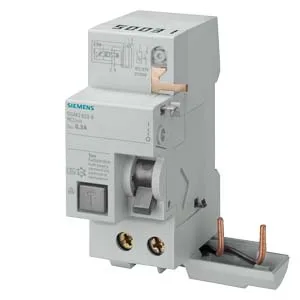
The Siemens 5SM2322-3 is a 2-pole RCD-unit from the SENTRON family, designed as a short-time delayed Type F residual current device. It's rated 40 A with a 30 mA trip threshold, intended for 230 V AC circuits at 50 Hz. Type F means it handles mixed-frequency residual currents — the kind you get from variable-speed drives, washing machines, or other single-phase electronics that inject DC components or higher harmonics onto the line. The short-time delay (selective) characteristic lets it coordinate downstream with instantaneous RCDs, so the closest device trips first on a ground fault, not the main. Rated insulation voltage is 460 V, surge voltage resistance is 4 000 V, and it handles a 3 kA surge current — figures that confirm it's built for overvoltage category III environments, typical of fixed-installation distribution panels.
Temperature derating and panel placement
The 40 A rating holds at 40 °C (37.2 A) and 45 °C (37.2 A), then derates stepwise to 32 A at 70 °C. That means in a warm cabinet or next to high-current breakers, you lose about 20 % of the headline current — plan your load accordingly. Mounting position is any, fastening method is REG (regular DIN rail), and it takes 2 modular width units (about 36 mm) on the rail.
What it's not — peer contrast
The closest peer in the SENTRON family is the 5SU9304-1KK32, an RCBO (RCD + MCB combo) that's instantaneous, Type AC, and rated 32 A. That part is a 1-module unit with an integrated overcurrent trip, while the 5SM2322-3 is a 2-module pure RCD with short-time delay and Type F selectivity. If your panel needs overcurrent protection on the same device, the 5SU9304-1KK32 is the integrated route; if you need Type F discrimination and a separate MCB upstream, stick with the 5SM2322-3.