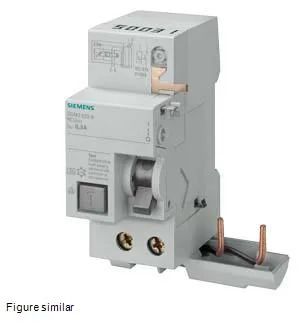
The 63 A AC rating is the continuous load current the main contacts carry; the real number that governs fit for most distribution boards is the 30 mA rated fault current, which is the sensitivity at which it trips. Type A means it detects pulsating DC residual currents as well as sinusoidal AC — essential on circuits feeding single-phase rectified loads like switched-mode power supplies, washing machines, or LED drivers. The instantaneous design means no intentional delay; it clears a fault within tens of milliseconds, so it is the primary protection device, not a time-delayed selector. At 50 Hz and AC voltage, it is built for standard mains-frequency distribution panels. The 2-pole construction switches both live and neutral on a single-phase circuit. Rated insulation voltage is 460 V, and overvoltage category III confirms it is rated for fixed-installation distribution boards, not for downstream socket outlets. The IP20 rating — with the note 'if the distribution board is installed, with connected conductors' — means the live busbars and terminals are finger-safe only when enclosed in a panel; it is not a standalone outdoor device.
Thermal derating — the number that matters for a loaded panel
The 63 A rating holds only at 40 °C ambient. Above that, the continuous current must be reduced: 58.6 A at 40 °C, 56.7 A at 50 °C, 54.81 A at 55 °C, 53.55 A at 60 °C, 52.29 A at 65 °C, and 50.4 A at 70 °C.