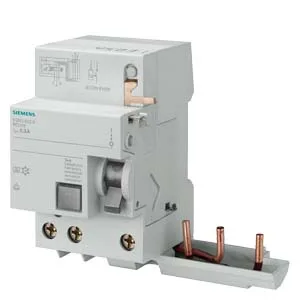
Selective (time-delayed) design means it coordinates with downstream RCDs, so a ground fault on a branch trips the local device first without dropping the whole submain. That matters in a distribution board feeding multiple circuits where nuisance tripping costs production time.
At 40 °C ambient the continuous current rating derates to 58.6 A; at 50 °C it drops to 56.7 A, and at 70 °C it's 50.4 A. The insulation voltage (Ui) is 460 V, so it's fine on 400/415 V three-phase networks common in industrial and commercial distribution. Surge current resistance is rated 5 kA, surge voltage resistance 4 kV — that covers most utility-side transients on a TN or TT system without external surge protection, though a coordinated SPD upstream is still good practice for sensitive electronics on the load side. Operating frequency is 50/60 Hz, so it's at home on either mains standard.
Occupies 3 modular-width units (each 18 mm) on a DIN rail — that's 54 mm of rail space. Depth is 70 mm, so it clears a standard 80 mm deep enclosure without the door hitting the conductors.