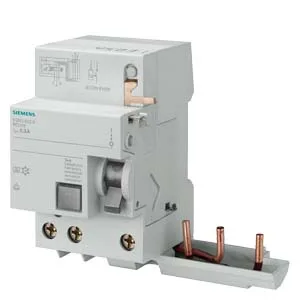
It operates on 50 Hz supply and is designed for 460 V insulation voltage (Ui), overvoltage category III, pollution degree 2. Ambient range from -40 °C up to 75 °C covers most industrial enclosures, though the continuous current derates above 40 °C — at 70 °C it's good for 50.4 A, so factor that into a tight panel.
Mounting and integration into a panel
Three modular width units (105 mm) on a DIN rail, 70 mm installation depth. The fastening method is REG (regular DIN-rail clip), mounting position any. No sealing option — standard IP20 with board installed. The 3-pole design covers single-phase or three-phase downstream loads; the instantaneous trip (no adjustable time delay) means it responds to the first fault cycle, which matters for coordination with upstream selective RCDs.
The 300 mA rated fault current is the trip threshold — type AC means it detects sinusoidal residual currents only, not pulsed DC or smooth DC. That's fine for general distribution where loads are resistive or inductive with standard rectifiers, but not for VFD-fed motors or UPS downstream that generate DC fault content (those need type A or B). The 460 V insulation voltage and 4 kV surge resistance (overvoltage cat III) suit it for 400 V three-phase panels common in crusher houses and conveyor lines. The -40 °C low end covers unheated outdoor substations; the 75 °C max handles the heat rise in a densely packed board. The false-tripping protection function is built in — it suppresses nuisance trips from transient surges or switching spikes that don't represent a real ground fault.