What the 63 A rating means in the panel
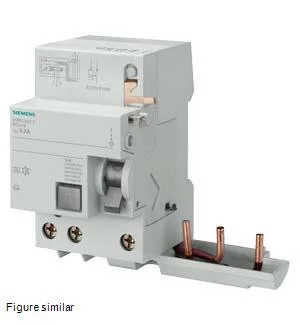
The Siemens 5SM2636-8 is a SENTRON selective RCD unit — a residual-current device designed for Type A fault detection (AC and pulsating DC) at a fixed 300 mA trip threshold, rated 63 A across three poles on 50/60 Hz AC supply. Selective (time-delayed) means it coordinates downstream so a fault on a sub-circuit trips the branch RCD first, keeping this unit closed and the main bus live — critical in distribution boards feeding multiple sub-panels or heavy loads like motor control centres. The 63 A AC-1 rating (resistive load) is the headline number, but the real-world current capacity drops with panel ambient temperature: 58.6 A at 40 °C, 56.7 A at 50 °C, and 50.4 A at 70 °C.
Integration into the distribution board
Mounting position is any orientation; supply can enter top or bottom. The 460 V rated insulation voltage (Ui) and 4 000 V surge withstand confirm it handles the transients common on 400 V three-phase networks.
What the Type A and 300 mA rating decide
Type A residual current detection catches both sinusoidal AC faults and pulsating DC — the kind generated by single-phase rectifiers in VFDs, switched-mode supplies, or LED drivers. The 300 mA trip threshold is deliberately high: selective RCDs at this level are used for fire protection or main-switch duty, not personnel protection (which requires 30 mA). The 5 kA surge current resistance means it withstands lightning or switching surges without nuisance tripping — a common requirement on incoming supply feeders.