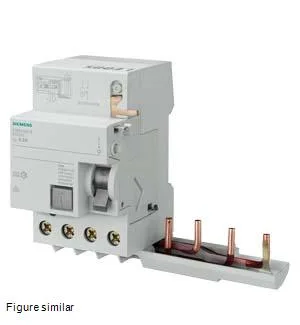
Selective RCD for downstream coordination
The Siemens 5SM2646-8 is a selective RCD unit from the SENTRON family, designed to provide time-delayed ground-fault protection so a downstream RCD trips first — the selective design keeps this unit from nuisance-tripping on transient faults and ensures the upstream device stays closed during a downstream fault. Rated at 63 A AC and 300 mA Type A residual fault current, it handles the main feeder or sub-feed in a distribution board where coordination with branch RCDs is required. Four-pole construction (4 poles) covers three-phase plus neutral, with a 50/60 Hz operating frequency and an insulation voltage (Ui) of 460 V.
The 300 mA tripping threshold is higher than a standard 30 mA RCD — this is intentional for a selective (time-delayed) device. It allows downstream 30 mA RCDs to clear a fault first, while the 5SM2646-8 waits through the delay and only trips if the fault persists. That selectivity is what protects the rest of the panel from a full blackout on a branch fault. Type A detection means it responds to AC sinusoidal residual currents and pulsed DC residual currents up to 6 mA smooth DC — covers the typical rectified waveforms from single-phase power supplies and VFDs you'd find in a mixed-load panel. Temperature derating is published: 58.6 A at 40 °C, dropping to 50.4 A at 70 °C. Factor that into the load schedule.
Fastening method is standard REG (regular) snap-on. Supply connection can be top or bottom. The unit is not sealable and has no adjustable time delay or adjustable fault current — it's a fixed-setting selective device, no field calibration required.