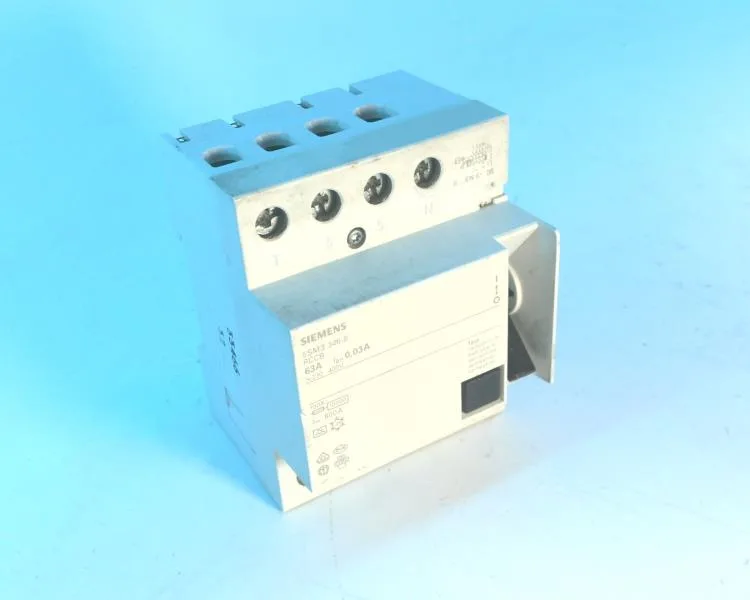
The Type A designation means it detects pulsating DC fault currents, not just pure AC sine-wave faults, so it covers modern electronics like variable-speed drives, LED drivers, and switching power supplies that generate half-wave rectified leakage. The short-time delayed characteristic means this unit won't trip on transient inrush or brief capacitive leakage — it's built for circuits with a known start-up surge, like motor feeders or capacitor banks, where a standard instantaneous RCCB would nuisance-trip. The thermal overload protection adds a bimetallic element that tracks the load current and trips on sustained overcurrent, combining residual current and overload protection in one device.
The 63 A rating at 400 V AC three-phase means this RCCB handles the full load of a moderate sub-distribution board — think lighting circuits, socket outlets, or a small machine supply. The 30 mA residual trip is the standard for socket-outlet circuits and general wet-location protection per IEC 60364. The Type A waveform coverage is mandatory in many European installations where single-phase electronic loads are present — a standard Type AC RCCB may not detect the pulsating DC fault from a failed rectifier. The short-time delay gives you selectivity with downstream 30 mA RCCBs: the downstream unit trips first on a ground fault, leaving this one closed to keep the rest of the board live. Terminals accept solid or stranded conductors from 1.5 to 25 mm² — that's enough for the 63 A feed (typically 16 mm² Cu) and the outgoing circuits. Tightening torque is 2.5 to 3 N·m, standard for screw-type terminals in this class. The unit occupies 4 width units at 70 mm installation depth, so it fits a standard 4-module DIN-rail slot in any distribution board.