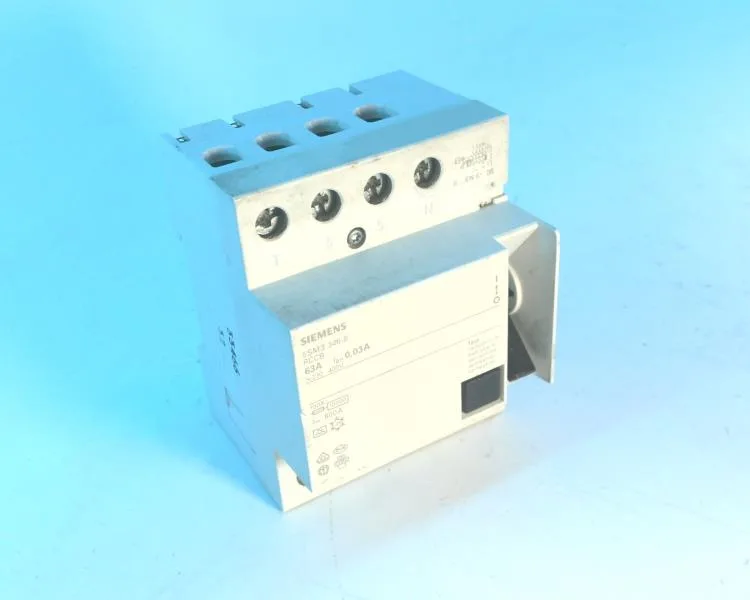
The Siemens SENTRON 5SM3354-6 is a 4-pole residual current circuit breaker (RCCB) with Type A fault current detection, rated 40 A at 40 °C and 45 °C, and 500 V AC supply voltage. Type A means it detects sinusoidal AC residual currents plus pulsating DC residual currents up to 6 mA — the standard choice for circuits with single-phase rectifiers, switched-mode power supplies, or electronic loads that generate pulsed DC fault currents. The 0.8 kA rating per EN 60898 and IEC 61008-1 is the conditional short-circuit capacity with the specified backup fuse — a lower number that governs coordination with the upstream protective device. The IP20 rating applies only when the distribution board is installed with connected conductors; this is normal for panel-mounted devices and means no special ingress protection is needed inside the enclosure.
Above that, derate linearly: 38.4 A at 50 °C, 36.8 A at 55 °C, 35.2 A at 60 °C, 33.6 A at 65 °C, and 32 A at 70 °C.
Supply connection can enter from top or bottom — no mandatory feed direction. The device is finger and back-of-hand safe per the protection-against-electrical-shock spec, so live terminals are shielded during maintenance. Silicon-free construction (marked yes) matters for automotive or paint-shop environments where silicone outgassing can cause adhesion failures.