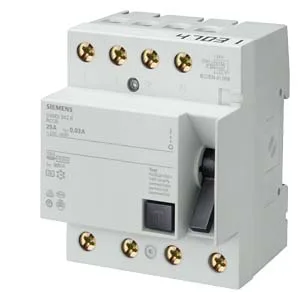
What this RCCB does and where it fits
The Siemens 5SM3445-6 is a 4-pole residual current circuit breaker (RCCB) from the SENTRON family, rated 125 A at 50 Hz with a 100 mA Type A residual current trip. It is an instantaneous device — no short-time delay — so it trips as soon as the fault current exceeds the threshold. Type A detection covers sinusoidal AC residual currents plus pulsating DC residual currents up to 6 mA smooth DC — the standard choice for circuits with single-phase rectifiers, switched-mode power supplies, or electronic loads that produce pulsed DC faults. The 100 mA trip threshold suits sub-main or feeder protection where nuisance tripping from leakage on long cable runs or multiple SMPS loads needs to be avoided. Mounts on DIN rail (REG) in any position, which gives panel builders flexibility in crowded enclosures. The 4-modular-width (72 mm) body and 77 mm depth fit standard distribution board cutouts. Supply can enter from top or bottom, so it works in both feed-through and reverse-fed configurations common in retrofit work.
Thermal derating — the real-world current limit
Above that, the device derates linearly: 117.5 A at 50 °C, 110 A at 55 °C, 102.5 A at 60 °C, 95 A at 65 °C, and 87.5 A at 70 °C.
Rated breaking capacity per EN 60898 is 1.25 kA; per IEC 61008-1 it is also 1.25 kA. The device is silicon-free, which matters in potting or conformal-coating environments where silicone outgassing can cause contact or adhesion failures. IP20 applies when installed in a distribution board with conductors connected — the enclosure provides the ingress protection.