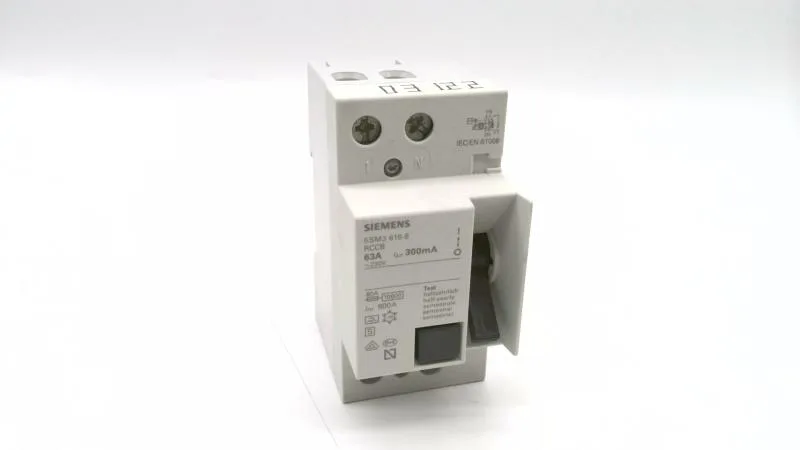
The Siemens SENTRON 5SM3614-8 is a 2-pole residual current operated circuit breaker (RCCB), Type A selective, rated 40 A at 230 V AC with a 300 mA residual trip threshold. Selective (short-time delayed) design means it coordinates with downstream RCCBs — in a fault, the downstream device trips first, keeping this one closed to avoid blacking out the whole submain.
The 300 mA residual trip threshold is the key selection parameter — this is not a personnel-protection device (those are 30 mA). It's sized for equipment protection and fire prevention on sub-distribution boards where nuisance tripping from leakage currents in long cable runs or multiple loads would be unacceptable. The 40 A continuous rating matches a typical sub-feed or feeder circuit; the 5 kA surge current withstand means it survives line transients without welding contacts. The 10 000 mechanical switching cycles is standard for a panel RCCB — not a daily-switch duty, but fine for infrequent manual test and isolation. Terminals accept 1 to 16 mm² solid or stranded copper, torqued to 2.5–3 N·m. That covers the full range from a 1.5 mm² control circuit to a 16 mm² feeder. The 70 mm installation depth and 36 mm width (2 modular units) are standard for a 2-pole SENTRON RCCB — it occupies the same DIN-rail footprint as a 2-pole MCB, so panel layout swaps are straightforward.
Snaps onto DIN rail, any mounting position. Ambient operating range -25 to +45 °C; storage range -40 to +75 °C. Overvoltage category III confirms it's rated for fixed-installation distribution panels, not for downstream equipment-level protection.