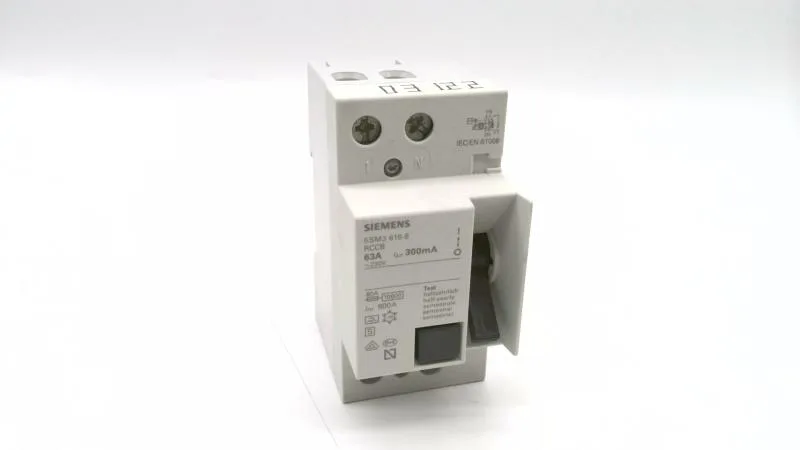
The selective design (short-time delayed) means it coordinates with downstream RCDs — in a fault, the downstream device trips first, keeping this unit as the backup, which is essential for supply continuity in distribution boards where you need to isolate only the faulty branch. Snaps onto a DIN rail (REG profile) and occupies 2.5 width units (roughly 45 mm).
Selectivity and coordination — why the 300 mA matters
The 300 mA trip threshold and selective characteristic are the key differentiators here. Standard RCCBs (non-selective) trip at 30 mA or 100 mA within milliseconds. This unit is engineered to withstand transient earth faults and let downstream 30 mA devices clear the fault first. That means you can place it as the main incoming RCCB feeding multiple sub-circuits, each with its own 30 mA RCCB, without nuisance tripping on the main. The 10 kA short-circuit current rating (IEC 60947-2) confirms it can handle a hard fault upstream without welding contacts. The 5 kA surge current resistance (8/20 µs impulse) means it survives lightning-induced surges common in industrial mains without degrading. Overvoltage category III (distribution level) is standard for fixed-installation switchgear.
Terminals accept solid or stranded conductors from 1.5 mm² up to 25 mm² — covers everything from a 2.5 mm² lighting circuit tail to a 16 mm² main feed. Tightening torque is 2.5 to 3 N·m, typical for screw terminals on this class of device. If your panel uses a right-neutral busbar, you will need the 5SM3616-8KR variant instead. Finger and back-of-hand safe construction (VDE 0660) means no exposed live parts when the front cover is closed.