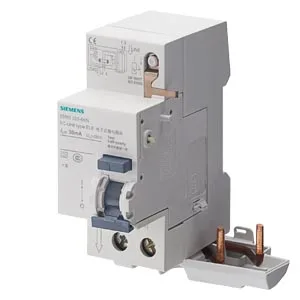
It's a 2-pole device rated at 63 A and 400 V AC, with a 30 mA trip sensitivity — the standard threshold for personal protection against direct contact in IEC 60364 installations. This is a Type A residual current device (RCD), meaning it responds to sinusoidal AC fault currents and also to pulsating DC fault currents — the kind you get from rectified loads like variable-speed drives, switched-mode power supplies, and single-phase electronics. That's the deciding spec for fit: if your downstream load includes semiconductor switching, a Type AC unit won't catch the pulsating DC component, but this Type A will.
The 63 A rating covers the full range of the 5SL4 MCB it mounts to, so you're not bottlenecking the breaker's overcurrent capacity. The 30 mA trip threshold is the IEC 60364-4-41 standard for socket-outlet circuits and hand-held equipment in most commercial and industrial installations — it's fast enough to prevent ventricular fibrillation in a direct-contact fault. That's enough to ride through most switching transients and nearby lightning-induced surges without nuisance tripping, but if the installation is in a high-exposure location (e.g., rural overhead supply, long outdoor runs), you'd want to check the expected surge level against this figure.
The unit is 36 mm wide (2 width units of 18 mm each), 100 mm tall, and 70 mm deep including the installation depth — that depth is the same as the 5SL4 breaker it couples to, so the combined assembly stays within the same enclosure depth budget. The power supply connection position is specified as top, above the miniature circuit breaker, which is the standard feed-through arrangement: line in at the top, load out at the bottom of the 5SL4. Terminal capacity accepts solid conductors from 0.75 to 35 mm² and stranded conductors from 0.75 to 25 mm² — that's generous for a 63 A device and covers most panel wiring up to that current. Tightening torque range is 2.5 to 3 N·m, typical for screw-type terminals in this current class.
Environment and approvals
Protection class is IP20 only when the distribution board is installed with connected conductors; this is not a field-mounted standalone device and expects to live inside an enclosure. Silicon-free construction is noted, which matters for applications where silicone outgassing can contaminate sensitive contacts or optics.