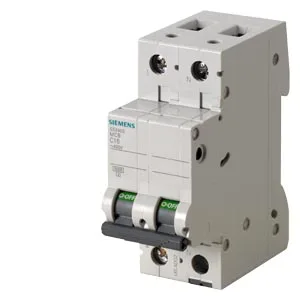
For motor or transformer starting with higher inrush, a D-curve would be the better fit; for purely resistive loads or long cable runs where nuisance tripping is a concern, a B-curve is sometimes preferred. This unit switches the neutral pole (1P+N) so that when the breaker trips, both line and neutral are disconnected — a requirement in many national wiring rules for final subcircuits. The 25 mm² solid conductor capacity on the terminals is generous for a 10 A breaker — it accommodates the incoming supply tails common in residential boards without needing a reducer.
Integration and environmental fit
The sealable design allows the distributor to lock the cover after commissioning to prevent tampering. Touch protection is built into the terminals per the product feature listing.
Coordination and selectivity notes
Energy limitation class 3 means this breaker limits the let-through energy (I²t) to a low level, which helps achieve selectivity with upstream devices — a 63 A or 80 A SENTRON SMCB or NH fuse upstream will typically remain closed during a downstream fault on this 10 A unit. This allows remote status monitoring or emergency shutdown integration without replacing the MCB.