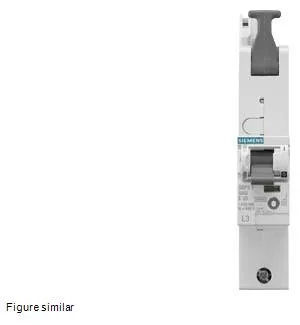
It's designed for residential and infrastructure metering panels, mounting on a 40-mm busbar system per DIN 43870 Part 2. The E curve (tripping characteristic class E) means magnetic trip thresholds are higher than a standard B or C curve, intended to ride through inrush from transformers or long cable runs without nuisance tripping — typical for main incoming breakers in European meter cabinets.
Mounts directly on a 40-mm busbar system compliant with DIN 43870 Part 2 — the standard meter-panel rail. No DIN-rail adapter needed; it clips onto the busbar with integral spring contacts for the line side. Occupies 1.5 width units in the cabinet grid. That's a wide range — fine for a 50 A feed on 10 mm² or 16 mm², but also big enough for parallel runs or a heavier main tail. Outgoing feeder uses spring-loaded terminals, so no screw tightening on the load side. Infeed at the box terminal (top) is stipulated by the installation position in the lower section of the meter panel. IP40 with conductors connected — protects against solid objects >1 mm but not water ingress. Not for outdoor or washdown locations; keep it inside the sealed meter enclosure.
Shock rated at 30 g (3 impacts, 11 ms duration); vibration 2 g per IEC 60068-2-6 (20 cycles, 5–150 Hz). That covers typical utility cabinet vibration from transformer hum or nearby switching gear. Sealable with a locking slide, wire seal, cable ties, or Antilux — common requirement for utility meter locks to prevent tampering. Switch position indicator shows OFF = green, ON = red.
Designed per EN 60898 (breaking capacity 25 kA) and carries overvoltage category IV. Insulation voltage rated 690 V. The product designation follows DIN EN 61346-2 and DIN EN 81346-2 (function code F).