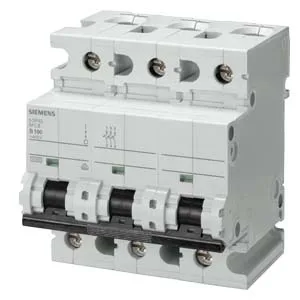
The B-curve means it trips magnetically between 3 and 5 times rated current — so at 300 A to 500 A fault current it opens in under 100 ms. That's the curve you spec for resistive loads, general-purpose lighting circuits, or any branch where you don't want nuisance tripping from mild motor inrush. For motor circuits you'd want a C-curve (5-10x In); for transformer or drive input, a D-curve (10-20x In). This one is B, so keep that in mind if you're swapping it into a panel that feeds a pump. In a commercial or light industrial panel with a transformer feeding 400 V, that 10 kA SCCR covers most branch circuits unless you're right at the main switchboard where fault current can hit 25 kA or more. For those positions, step up to an SENTRON 5SY series with 25 kA or 50 kA rating.
Panel fit and mounting — DIN rail, screw fixing, and that 76 mm depth
The 81 mm width times three poles means it occupies 4.5 modular width units (a 9 mm module is standard for Siemens MCBs). So in a 12-module row you fit two of these with three modules left over for a smaller single-pole breaker or a shunt trip. Tunnel terminals top and bottom accept copper conductors up to 35 mm² typically (check your local code). The terminals are sealable — there's a provision for a lead seal or a tamper-evident sticker, which matters for utility metering or any circuit that needs to stay locked after commissioning. IP20 with connected conductors, IP40 at the handle area with the distribution cover fitted — that's standard for panelboard use, not outdoor or washdown.
Lifecycle and sourcing — still active, no LTB worry
For compliance documentation: the 5SP series carries CE marking per the Low Voltage Directive, and Siemens provides a Declaration of Conformity on request. The part is halogen-free and silicon-free — that matters for high-reliability environments like data centers or medical facilities where outgassing from a fault can damage sensitive equipment.