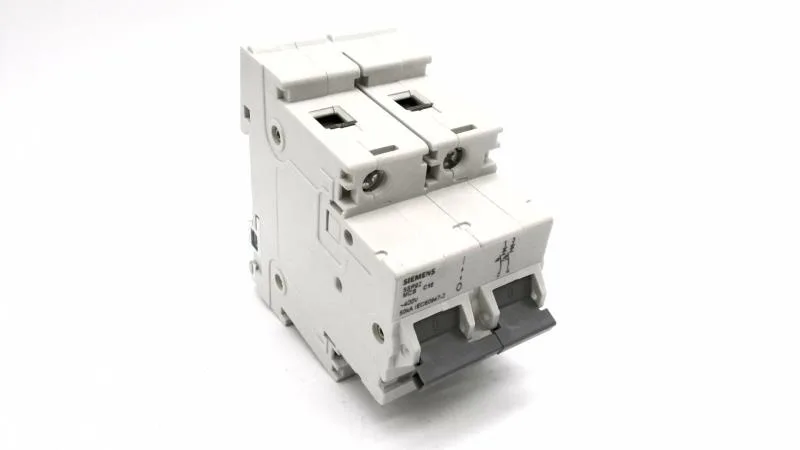
The C-curve means it tolerates inrush currents 5–10 times the rated current before tripping magnetically — the standard choice for motor and transformer branch circuits where the starting surge would nuisance-trip a B-curve breaker. The 63 A rating on a 2-pole frame means this breaker handles a 400 V AC, 50 Hz single-phase or two-leg load up to that continuous current. The tunnel terminals accept solid or stranded conductors from 0.75 mm² up to 50 mm² (AWG 14 to 2/0), which is a wide grip — it lands a 50 mm² feeder without needing a pin lug or reducer. Terminal torque spec is 2.5–3.5 N·m (22–31 lbf·in), so a standard screwdriver with a torque-limiting handle is the right tool; under-torquing on a 50 mm² conductor creates a high-resistance joint that runs hot. Mounts on standard DIN rail or with screw fixing, any orientation. At 3 width units (roughly 54 mm on a 18 mm/module rail), it occupies three adjacent slots — plan the gland plate and wireway fill accordingly.
This MCB is designed for DIN-rail mounting in industrial distribution boards, sub-distribution panels, and machine control cabinets. The 2-pole C-curve 63 A profile makes it a natural fit for feeding a downstream sub-panel, a large single-phase load (e.g., a 400 V heating element or a 230 V load across one pole), or as the branch-circuit protection for a group of motor starters where the combined running current stays under 63 A. Halogen-free and silicon-free construction matters in environments where off-gassing from a fault could damage sensitive electronics or where silicone contamination interferes with paint adhesion or contact reliability. The -25 to +45 °C ambient range covers most indoor industrial panels; storage tolerance down to -40 °C is fine for unheated warehouses. Shock and vibration ratings per IEC 60068-2-27 and IEC 60068-2-6 confirm it survives transport and moderate machine vibration without nuisance tripping.