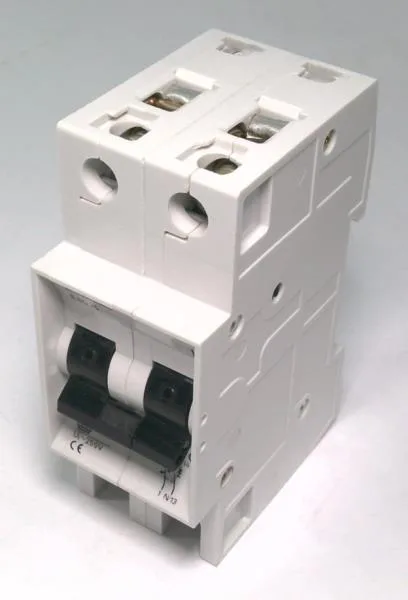
That neutral switching is the key difference from a standard single-pole MCB: it isolates the neutral when the breaker trips, which matters for any circuit where you want full disconnection on fault, not just the live side. Rated 16 A at 240 V AC with a B-curve tripping characteristic, it's sized for residential or light commercial final circuits where the load is mostly resistive or low-inrush — lighting, general-purpose sockets, small appliance feeds. Breaking capacity sits at 3 kA per EN 60898. If your site has higher fault levels (say, closer to a transformer), you'd step up to a 6 kA or 10 kA rated MCB, but for a typical consumer unit or sub-distribution board this is the right call. The part carries IP20 protection — that's finger-safe on the front but no ingress protection against water or dust. It's designed for enclosed installation inside a distribution board or control panel, not for wet or outdoor locations.
The 55 mm installation depth and 2 width units mean it drops into standard DIN-rail distribution boards without any panel modification — same footprint as the bulk of SENTRON 5SQ series MCBs. If you're replacing a failed unit or filling a BOM position, the mechanical fit is consistent across the range.
The B-curve trips between 3 and 5 times rated current — so for this 16 A breaker, magnetic trip occurs between roughly 48 A and 80 A. That's the standard choice for residential and commercial final circuits where you don't have high inrush from motors or transformers. If your load had significant starting current (a small compressor, a pump), you'd want a C-curve to avoid nuisance tripping. For this part, the B-curve tells you it's meant for general-purpose socket outlets and lighting.