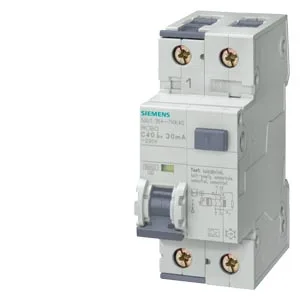
The Siemens 5SU1154-1KV10 is a combined residual-current device and miniature circuit breaker — an RCBO — in a single 1+N-pole module. It protects a final subcircuit against both earth leakage and overcurrent in one DIN-rail unit, saving a slot in the panel compared to separate RCD and MCB. The residual element is Type AC, meaning it detects sinusoidal AC earth fault currents only. That covers standard resistive and inductive loads — heaters, lighting, socket outlets — but not pulsed DC or smooth DC fault shapes you get from VFDs, UPSs, or EV chargers. If the downstream load includes any power-electronics front end, you need a Type A or Type F device instead.
We source the 5SU1154-1KV10 to order against an RFQ.
The 30 mA rated residual operating current (IΔn) is the standard threshold for personal protection against indirect contact in TN and TT systems. It limits touch voltage below 50 V in a grounded installation — the same level used across most socket-outlet circuits in IEC 60364-compliant designs. The C-curve (10 A) trips magnetically between 5× and 10× In, so 50 to 100 A for a short-circuit fault. That suits loads like small compressors, pumps, and fluorescent lighting where the starting surge is higher than a B-curve would tolerate without a nuisance trip. D=70 mm refers to the depth of the device — the dimension that projects forward from the DIN rail. At 70 mm it sits flush with most distribution board enclosures, leaving clearance for wiring and cover fit. The 1+N-pole format switches the line conductor and monitors the neutral; the neutral pole is not switched in all RCBOs, so confirm your wiring scheme before terminating.