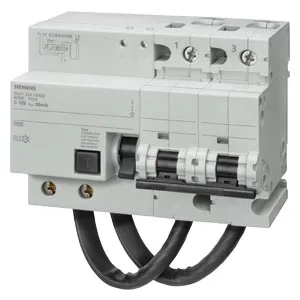
The Siemens SENTRON 5SU1324-6KK82 is a 2-pole (2P) RCBO — a combined overcurrent and residual-current device — rated 125 A at 30 °C with a B-curve trip characteristic and 30 mA Type A residual current protection.
The 125 A rating at 30 °C is the headline number, but the derated values matter more for a warm enclosure: at 40 °C it carries 115.62 A, at 50 °C it drops to 106.25 A, and at 60 °C it's 96.25 A. If your panel ambient runs 45 °C, plan for 111.25 A continuous — not the full 125 A. For motor or transformer circuits with higher inrush, a C-curve sibling would be the usual pick. Type A residual current detection means it catches both sinusoidal AC faults and pulsating DC faults — the kind a single-phase rectifier load (switched-mode supply, LED driver, washing machine) can produce. That covers most modern final circuits; Type AC would miss the pulsating component. Rated 50 Hz only — not 50/60 Hz. If the installation is on a 60 Hz supply (North America, parts of South America and Japan), this RCBO is not the correct fit. Pollution degree 2 is the normal indoor-panel condition.
The 77 mm depth and 117 mm width (7 modular width units) fit a standard distribution board cutout. Installation depth is 70 mm — the rail-to-front-panel clearance needed. Supply can enter from either top or bottom; mounting position is any orientation. IP20 with the distribution board installed and conductors connected — normal for an enclosed panel. Touch protection is built into the terminals. Halogen-free and silicon-free construction, which matters for clean-room or semiconductor-adjacent installations where outgassing can contaminate optics or sensitive surfaces.