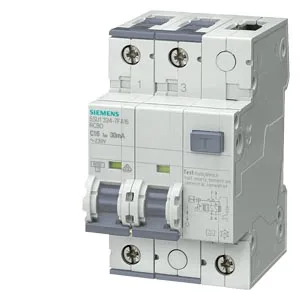
The Siemens 5SU1324-7FM16 is a 2-pole RCBO (residual current circuit breaker with overcurrent protection) from the SENTRON 5SU1 series, combining a Type A residual current device and a C-characteristic miniature circuit breaker in a single 3-module-wide unit (54 mm). It's rated for 230/240 V AC at 50 Hz, with a 10 kA breaking capacity per EN 60898 — the standard for household and similar installations, certifying its ability to safely interrupt fault currents up to that level. The C tripping curve means it's designed for inductive loads like small motors, pumps, and lighting banks where inrush current can exceed 5× the rated current.
The headline 16 A rating holds only at 30 °C ambient. In a sealed distribution board running at 40 °C — common in summer or crowded enclosures — the continuous current drops to 15.2 A. At 50 °C it's 14.4 A, and at 60 °C it's 13.6 A. If your panel ambient hits 70 °C, derate to 12.32 A. This is the number that governs real-world loading, not the 30 °C figure. For a pump drawing 14 A continuous at 45 °C, the 14.88 A derated value leaves only 0.88 A headroom — marginal for a circuit that won't nuisance-trip on a hot day.
Type A fault current detection — what it catches
If your downstream loads include any electronics that chop the sine wave, Type A is the minimum for code compliance in most IEC regions. The instantaneous design (no intentional time delay) means it trips within the standard RCD response time — no coordination with delayed RCDs upstream.
Halogen-free and silicon-free construction
Both the housing and internal insulation are halogen-free and silicon-free. That matters for installations in environments where outgassing from a fault arc could corrode nearby contacts — think data centers, medical equipment, or clean rooms.