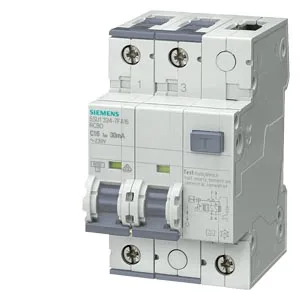
It's rated 6 A at 30 °C, with a 30 mA residual fault trip threshold and a 10 kA breaking capacity per EN 60898 — so it protects a final subcircuit against both overload/short-circuit and earth leakage in one device, saving a DIN row in the panel. Type A residual current detection means it catches pulsating DC fault currents from rectified loads — think LED drivers, switched-mode power supplies, or single-phase VFDs — not just sinusoidal AC leakage. That's the deciding factor for modern panels where you'd otherwise need a separate Type A RCD upstream.
Thermal derating and installation constraints
At 40 °C it derates to 5.7 A, at 50 °C to 5.4 A, and at 60 °C to 5.1 A — so if the panel runs hot (say a packed cabinet near a process oven), size the upstream protective device for the derated value, not the label current. The 3-module-width footprint (54 mm wide, 77 mm deep, 90 mm tall) occupies three 18 mm positions on a standard DIN rail. IP20 applies once the distribution board is installed and conductors are connected — so it's for enclosed panels only, not a standalone outdoor enclosure.