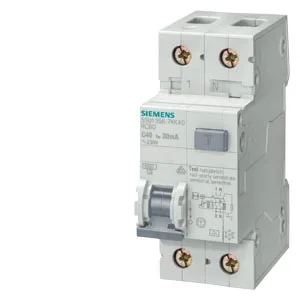
It protects a single-phase final subcircuit (1P+N, 2 MW wide) against overload, short-circuit, and earth leakage. The C-curve means it holds up to 5–10× rated current momentarily, so it is the standard choice for inductive loads like small motors, contactor coils, and fluorescent lighting where inrush exceeds a B-curve's tolerance. Breaking capacity is rated 4.5 kA per EN 60898 and 15 kA per IEC 60947-2. The higher IEC figure applies when the device is used as a circuit breaker in an industrial distribution board; the EN figure governs domestic/commercial installations. Either way, the 15 kA SCCR gives headroom for most panelboard fault levels without upstream fusing. The residual-current element detects AC fault currents only (Type AC). That covers sinusoidal earth leakage from live-to-ground faults in standard resistive and inductive loads.
Above that, the bimetallic strip trips earlier to protect the device and wiring. At 40 °C it is 7.52 A; at 50 °C it drops to 6.96 A; at 60 °C it is 6.48 A; at 70 °C it is 5.84 A. Factor this into the load schedule before committing the BOM line.
Width is 36 mm (2 MW), depth 77 mm, height 90 mm. Installation depth behind the panel is 70 mm. Mounting position is any orientation — no derating needed for horizontal or inverted fit. Terminals accept 0.75 mm² to 25 mm² — solid or stranded. The larger cross-section is useful for looping through downstream devices without a separate distribution block.