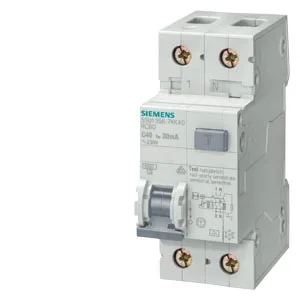
It's a 1P+N design: one protected pole plus a switched neutral. The residual-current element is integrated, so you get ground-fault protection without a separate RCCB upstream. That saves a DIN slot and simplifies wiring in a crowded panel.
Rated short-circuit capacity is 4.5 kA per EN 60898 (the household-and-similar standard) and 15 kA per IEC 60947-2 (the industrial standard). Energy limitation class 3 means it lets through less let-through energy than class 1 or 2, which reduces arc-flash risk and stress on downstream wiring. Insulation voltage is rated 264 V, surge voltage resistance 4 kV — adequate for 230/240 V line-to-neutral systems.
Temperature derating — don't ignore it
At 40 °C it's 30.4 A; at 50 °C it's 28.8 A; at 60 °C it's 27.2 A; at 70 °C it's 24.64 A. If your panel runs hot — and most do, especially with multiple RCBOs ganged together — you need to apply the derating curve or the breaker will nuisance-trip on a load well below its nameplate.
Width is 36 mm (2 modular units), depth 77 mm, height 90 mm, installation depth 70 mm. That's a standard DIN-rail footprint — drops into any SENTRON or third-party distribution board that accepts 2-MW devices. Supply can come from top or bottom; the neutral is switched internally, so no separate neutral bar needed downstream of the RCBO. IP20 with conductors connected and the distribution board installed — that's touch-finger protection only, not dust or water. Mount it inside a rated enclosure.