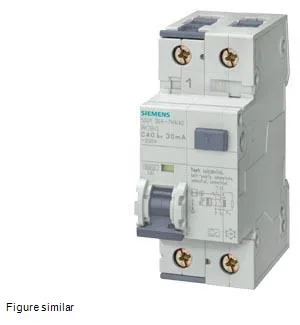
The Siemens 5SU1354-0LB25 is a SENTRON RCBO — a combined residual current circuit breaker with overcurrent protection — rated 25 A at 30 °C with a B-curve tripping characteristic and a 10 kA breaking capacity per EN 60898 at 230/240 V AC. It protects a 1P+N circuit (switched phase, solid neutral) and integrates both overcurrent and earth-leakage detection in a single 2-MW (36 mm) wide module.
The B-curve means the magnetic trip fires at 3 to 5 times rated current — so for a 25 A device, instantaneous trip between 75 A and 125 A. That's the standard SCCR for most final sub-circuits in a TN or TT system — it coordinates with a 10 kA-rated upstream MCB or fuse. The 50/60 Hz operating frequency covers both mains standards globally. The thermal derating curve is published: 25 A at 30 °C, 23.5 A at 40 °C, 22.75 A at 45 °C, 21.75 A at 50 °C, 20.25 A at 55 °C and 60 °C, 19.25 A at 65 °C, and 18.25 A at 70 °C (–). If this RCBO lives in a hot panel — say near a drive or transformer — size the load to the ambient temperature, not the 30 °C headline number. The -40 °C to 75 °C operating range means it holds up to steam and press temperatures in a tire-curing environment, as long as the enclosure keeps the IP20 rating intact. The RCBO detects AC fault currents only — it's not suitable for pulsating DC or smooth DC residual currents from VFDs or UPS systems. The design is short-time delayed G, super resistant K, meaning it withstands high inrush and nuisance tripping from capacitive or inductive loads better than a standard G type.